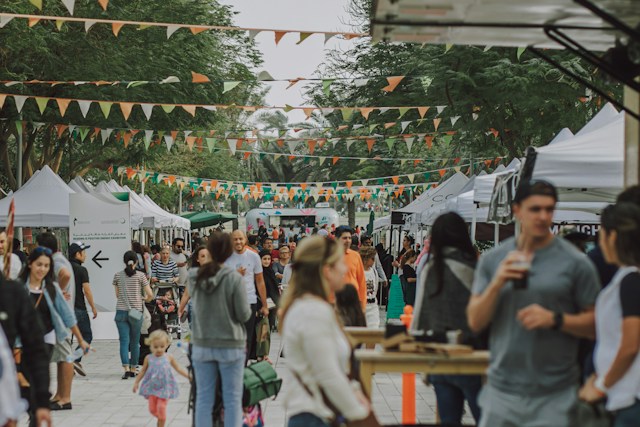
Fall Festival Food Vendors: What They Earn and What They Need
Lining up food vendors for a fall festival is mostly a recruitment problem, not a catering one. You are asking small businesses to give up a Saturday, and whether they say yes — and come back next year — depends on what the day is worth to them.
We can put some numbers against that. Across 803 community events, vendors reported what they actually sold and uploaded a receipt to back it up. It is not festival data exactly, and the gap matters, so it is worth being clear about that up front.
How Many Food Vendors Should a Fall Festival Book?
There is no reliable ratio of vendors to expected attendance. What our booking data does show is what a single truck tends to earn at a community event — around 23 to 43 orders and $400 to $500 in sales — which is less than the same truck charges as a minimum for private catering. Book the number each vendor can make worthwhile.
Anyone offering you a clean formula — one truck per 200 guests, say — is guessing. Turnout at community events is famously hard to predict, how many of those people buy food depends on the hour and the weather and what else is on offer, and a vendor's take depends heavily on where you put them.
What a Single Vendor Tends to Sell
Across 803 vendor visits, most sold to far fewer people than organizers tend to picture.
| Orders taken | Vendor visits | Share |
|---|---|---|
| Under 25 | 445 | 55% |
| 25–49 | 274 | 34% |
| 50–99 | 78 | 10% |
| 100–199 | 6 | 0.7% |
| 200 or more | 0 | — |
Where this data comes from, and where it stops
These are community events with an average of 1.1 vendors — mostly a single truck visiting an apartment community or neighborhood, not a festival with a row of stalls. A multi-vendor festival with real gate traffic is a different animal, and we do not have sales data for one. Read these numbers as a floor on what a vendor might earn on a quiet day, not as a ceiling on what yours will do.
One pattern holds even with that caveat. Larger declared attendance did not reliably produce larger sales: events expecting under 100 people averaged 31 total orders, and events expecting 2,000 or more averaged 44. Some of that is because attendance estimates at community events are notoriously optimistic — our industry report found HOA events averaging roughly 1,594 declared guests against about 32 actual buyers.
Crowd size surely matters. But it is that the number on your flyer is a weak predictor of what any one vendor takes home, so it is a poor basis for promising them anything.
How Much Does a Food Truck Make at a Community Event?
A food truck grosses about $400 to $500 at a typical community event, from roughly 25 orders at $18 to $20 each. That sits below the $750 to $1,000 minimum the same trucks charge for private catering, which is the single biggest reason vendors turn down community events or do not come back the next year.
That gap is the thing most organizers never see. A truck that spends a Saturday at your festival has given up a booking it would have charged a four-figure minimum for. Out of the $400 or $500 it takes come food costs, fuel, staff and a day of someone's weekend.
Which reframes your job. You are not recruiting vendors to feed a crowd; you are competing for their Saturday against a private event that pays better and asks less. The organizers who keep the same vendors year after year are the ones who make the day worth showing up to.
What a Fall Festival Costs You to Host
Usually nothing, which is the appeal. At most community events guests buy their own food and the organization pays the vendor nothing at all. You provide the crowd and the pitch; they take the risk and keep the takings.
The alternative is a minimum guarantee: you promise the vendor a floor, they keep whatever they sell, and if sales fall short you cover the difference. Given that typical takings run $400 to $500, a guarantee in that range costs you nothing most of the time and removes the vendor's reason to say no. For a first-year festival with no track record, it is often the difference between three vendors and eight.
If your event is one where the organization pays for everyone's food instead, that is a different model with different numbers — our breakdown of catering cost by guest count covers what that runs, and the cost guide breaks per-person rates down by cuisine.
The Logistics That Decide Whether Vendors Say Yes
Vendors accept or decline on operational detail long before they think about your cause. Four things matter more than the rest.
- Placement against foot traffic. The single biggest lever on what a vendor earns. A truck tucked behind the bouncy castle takes a fraction of what the same truck takes on the path between the entrance and the main stage. Walk your site and place vendors where people already have to go.
- Drivable access and a flat pitch. A truck needs roughly 25 feet by 10, on a surface it can reach and leave without being boxed in by the parking you set up afterwards.
- A realistic window. Four hours of trickle sells no better than two hours of concentrated crowd, and costs the vendor a whole day. Concentrate your program rather than stretching it.
- Telling them the truth about turnout. The fastest way to lose a vendor permanently is to promise 1,500 people and deliver 30 orders. Say what you genuinely expect, and they will price and staff for it.
Most trucks run off their own generator, so power is rarely the blocker people assume. Permits usually are — check with your city or county well ahead, since requirements for a public event differ from those for a private one.
If You Take One Thing From This
Your vendors are weighing your Saturday against a private booking that pays a four-figure minimum and asks less of them. You do not have to match that. You do have to be worth showing up for — which mostly means honest numbers, a pitch where people actually walk, and a window short enough that the day is not a write-off if turnout disappoints.
Get those right and the same vendors come back next year, which is worth more than any single festival.
Food Truck Club connects businesses and event planners with verified food truck caterers across 12 metro areas. With 345,000+ guests served and a 4.9-star Google rating, our guides are based on real event data, client reviews, and direct partnerships with food truck operators. Follow us on LinkedIn.
Lining Up Vendors for Your Festival?
Browse verified food trucks, tell us your date and expected turnout, and we will handle the vendor coordination.