Key Findings
Houston’s food truck economy runs on a different engine than most people assume. It isn’t festivals, breweries, or street corners — it’s employers. This report examines 956 confirmed food truck bookings across Greater Houston to understand who books, what they order, how much they spend, and where the market is headed. The answer, at nearly every turn, is the workplace: hospitals, energy campuses, distribution centers, manufacturing plants, and office parks.
Nine out of ten bookings come from organizations rather than private individuals — the most corporate-heavy ratio we’ve measured in any Texas market. Frontline-worker industries account for 54% of demand, American comfort food captures nearly half of all cuisine selections, and the average employer-paid event runs $2,340. Food trucks in Houston have stopped being event vendors and started being workplace infrastructure.
Five things the data tells us about Houston
- It’s a B2B market, full stop. Organizations drive 89.9% of food truck bookings — employee appreciation, recruiting, safety celebrations, and company milestones make up the backbone of demand.
- Essential industries are the customer base. Healthcare (16%), energy and utilities (14%), and logistics (11%) are Houston’s three largest segments, and frontline-worker industries collectively drive 54% of bookings.
- Comfort food wins. American comfort food — burgers, sandwiches, wings, pizza — captures roughly 45% of cuisine selections. Crowd-pleasing beats niche when you’re feeding a hospital shift or a plant floor.
- Two business models power the market. Employer-paid events average $2,340 and generate the highest booking values; attendee-paid events turn office parks, hospitals, and apartment communities into recurring lunch programs.
- Statewide licensing removes the biggest friction. Texas’s unified licensing framework replaces city-by-city permitting, cutting administrative costs and making multi-city operations practical for Houston-area trucks.
Figure ES-1 — Scope of the dataset
| Dimension | Figure | Detail |
|---|---|---|
| Confirmed bookings analyzed | 956 | Greater Houston area |
| Organizational booking share | 89.9% | Corporate & institutional buyers |
| Frontline-industry share | 54% | Healthcare, energy, logistics, manufacturing, construction |
| Avg. employer-paid event | $2,340 | Median $1,624 · typically 50–75 guests |
| Typical 50-person event | $795 | Routine appreciation-event budget |
| Top cuisine | American (~45%) | Burgers, sandwiches, wings, pizza |
Corporate Catering Is Fueling Houston’s Food Truck Industry
Organizations drive 89.9% of all food truck bookings in Houston, with private individuals accounting for just 10.1%. That makes Houston an even more corporate-heavy market than Dallas (80% corporate) — the strongest B2B skew we’ve measured. Houston’s strongest food truck demand comes from employers, not festivals.
The driver is a shift in what a food truck represents to a company. Trucks have evolved from event vendors into a repeatable workplace amenity — a tool HR and operations teams reach for whenever they need to create a visible moment for employees. In a metro where hospitals run around-the-clock shifts and plants sit miles from the nearest restaurant cluster, bringing the food to the workforce isn’t a novelty. It’s the practical option.
Employers, healthcare systems, property managers, schools, and institutions booking for their people.
Private celebrations, birthday parties, neighborhood gatherings, and personal events.
Figure 1 — What Houston employers book food trucks for
Employee appreciation
The single most common occasion — visible, low-lift recognition for staff.
Recruiting
Hiring events and open houses where the truck is part of the pitch.
Workplace culture
Recurring lunch programs that give campuses and plants a food amenity.
Safety celebrations
Milestone rewards for incident-free stretches at industrial sites.
Company milestones
Anniversaries, expansions, project completions, and record quarters.
Community engagement
Employer-hosted events that open the doors to families and neighbors.
Essential Industries Generate the Majority of Demand
More than half of Houston’s food truck bookings — 54% — originate from frontline-worker industries: healthcare, energy, logistics, manufacturing, and construction. Healthcare leads every segment at 16% of bookings, followed by energy and utilities at 14% and logistics and distribution at 11%.
The industry mix is distinctly Houston. No other Texas market puts energy and utilities in its top three — a direct reflection of the refineries, petrochemical plants, and utility operations that ring the metro. Combine that with the Texas Medical Center’s enormous healthcare workforce and the Port of Houston’s distribution corridor, and you get a customer base of large, shift-based workforces that can’t leave the site for lunch. These are exactly the workplaces where a truck in the parking lot solves a real logistics problem.
Figure 2 — Booking share by industry
The remaining 29% of bookings spans office, retail, hospitality, government, and other industries. Healthcare, energy, and logistics together represent Houston’s three largest customer segments.
Why this matters for operators
Hospitals, plants, and distribution centers run multiple shifts, enforce site-access protocols, and book on procurement timelines. Operators who adapt — serving night shifts, carrying insurance documentation, invoicing instead of demanding card-at-window — gain durable access to Houston’s largest and most repeatable demand segments.
Employer-Paid vs. Attendee-Paid Events
Two business models power Houston’s food truck market. In employer-paid events, the company covers every meal — averaging $2,340 per event for a typical 50–75 guests. In attendee-paid events, the host books the truck but individuals buy their own food, typically spending $15–$18 per guest at events that draw 100 or more potential customers.
The two models do different jobs. Attendee-paid visits are how food trucks become a standing amenity — the weekly lunch rotation at an office park, hospital campus, or apartment community that costs the host nothing and builds a routine audience. Employer-paid events are the revenue engine: higher-value, purpose-driven bookings for appreciation days, recognition events, and celebrations. In practice they feed each other — a truck that proves itself in a weekly rotation is the first call when the same site plans a paid appreciation event.
Employer covers full cost. High-value B2B sale. Revenue driver.
Individuals pay. Zero host cost. Recurring workplace dining at office parks, hospitals, apartments, and plants.
American Comfort Food Dominates Corporate Catering
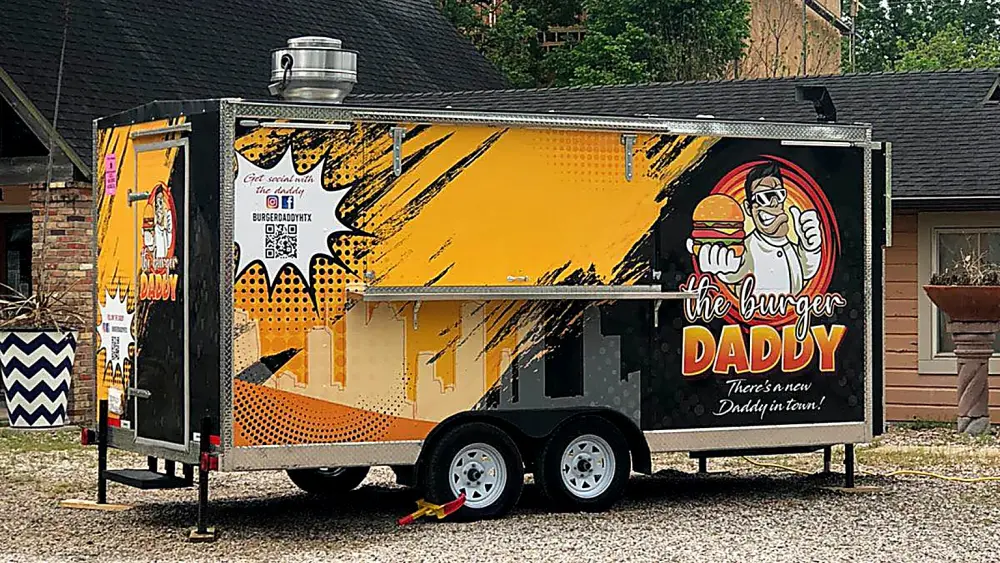
American comfort food captures roughly 45% of all cuisine selections in Houston — burgers, sandwiches, wings, pizza, and other crowd favorites. In a city celebrated for its culinary diversity, that may seem surprising. But corporate buyers aren’t browsing for themselves; they’re feeding 50 to 200 people with one truck and one service window. Universal appeal maximizes participation and minimizes complaints.
Mexican and Tex-Mex holds second place at 14–16% — among Houston’s most requested categories, and often the second truck added at larger events. Dessert trucks (8–10%) are the appreciation-event specialists, and BBQ (6–8%) is a reliable pick for larger corporate gatherings. The remaining quarter of the market spans Asian, Mediterranean, Cajun, seafood, Italian, coffee, and fusion concepts — a long tail that mirrors the city’s food scene even if no single category commands a large share.
Figure 4 — Cuisine popularity (share of selections)
Shares are presented as ranges from source data; bar lengths use range midpoints. “Other” aggregates many small categories — no single cuisine within it approaches the top four.
The takeaway for operators mirrors what we found in Dallas: Houston’s corporate market is a volume game. Trucks that execute familiar menus quickly and consistently — a burger line that can serve 75 people in an hour — will find more repeat corporate demand than novel concepts competing for the same buyers. Specialty trucks still win the quarter of the market that wants variety, but the core demand rewards reliability.
What Food Truck Catering Costs in Houston
The average employer-paid food truck event in Houston runs $2,340, with a median of $1,624 — the gap between the two reflects a set of large corporate events that pull the average up. The more useful planning number for most buyers: a routine 50-person event averages $795.
That spread is the most important pricing insight in this report. Large celebrations and multi-truck events raise the average, but the typical employee-appreciation lunch remains squarely affordable — under $800 for 50 people. Employers don’t need an annual-party budget to put a truck in the parking lot; they need roughly $16 per person. That’s why food trucks have become a routine engagement tool rather than a once-a-year splurge.
Average Event
Employer-paid, all sizes
Median Event
Half of events cost less
50-Guest Event
Average routine booking
Figure 5 — Typical Houston food truck pricing by cuisine
| Cuisine Type | Price / Guest | Typical Minimum |
|---|---|---|
| Cajun & Seafood | $16–$22 | $1,000 |
| Pizza | $14–$17 | $1,000 |
| BBQ | $16–$20 | $900 |
| Asian Cuisine | $14–$17 | $800 |
| Burgers & American | $13–$16 | $600 |
| Tacos / Tex-Mex | $12–$15 | $600 |
| Hot Dogs | $10–$13 | $500 |
| Coffee & Beverage | $5–$8 | $350 |
Minimums represent the lowest amount a truck will typically accept to come out to an event. Highlighted minimums ($800+) reflect higher prep and ingredient costs.
For budgeting, the per-guest range is the number to use: multiply expected headcount by $12–$16 for mainstream cuisines, add 15–20% for appetite variability, and check the result against the truck’s minimum. A 40-person taco lunch clears a $600 minimum comfortably; a 25-person Cajun event won’t clear $1,000, which is why smaller groups gravitate toward burgers, tacos, and hot dogs.
The Economics of Operating a Houston Food Truck
Food and labor together consume roughly two-thirds of a typical food truck’s operating budget — ingredients run 35–40% of costs and labor another 25–30%. Vehicle and fuel expenses add 10–15%, with insurance, licensing, and maintenance claiming most of the remainder.
That cost structure explains why consistent bookings matter more than premium pricing. A truck’s biggest expenses scale with every service, so idle days are what kill margins — not ingredient costs. It also explains the pull toward corporate catering: an employer-paid event with a guaranteed minimum beats a speculative festival slot where revenue depends on foot traffic and weather. Houston’s deep bench of recurring workplace programs gives operators something rare in this industry: a predictable calendar.
Figure 6 — Typical food truck operating cost breakdown
Shares are presented as ranges from source data; bar lengths use range midpoints. Individual trucks vary with cuisine, fleet age, and commissary arrangements.
Texas Simplifies Food Truck Licensing
Texas is replacing city-by-city food truck permitting with a statewide licensing framework — one license, one compliance process, valid across jurisdictions, with health and safety oversight intact. For Houston-area operators, it’s the most consequential regulatory change in years.
Greater Houston is a patchwork of jurisdictions — Houston proper, Sugar Land, The Woodlands, Katy, Pasadena, Baytown, and dozens more. Under the old model, each came with its own permits, inspections, and fees, which meant most trucks simply didn’t serve the full metro. A single statewide license removes that constraint precisely where Houston’s corporate demand lives: the suburban campuses, plants, and distribution centers scattered across county lines.
- ✕Separate permitting in each city
- ✕Multiple inspections for the same truck
- ✕Duplicate licensing requirements
- ✕Higher administrative costs
- ✕Limited operating flexibility
- ✓Statewide licensing framework
- ✓Streamlined compliance
- ✓Reduced administrative burden
- ✓Easier multi-city operations
- ✓Continued health and safety oversight
The framework is expected to improve operating efficiency and support continued growth of corporate food truck catering across the state. Buyers should feel it as more choice — trucks that previously stayed inside one jurisdiction can now bid on events across the metro.
Outlook for the Houston Food Truck Market
Every structural signal in this dataset points the same direction: Houston’s food truck market is consolidating around workplace catering, and the forces feeding that shift are all still accelerating.
Four Forces Shaping the Next 12 Months
Food trucks in Houston have crossed from novelty to infrastructure. With nine of every ten bookings coming from organizations, the market’s trajectory is tied to how Houston’s employers invest in their people — and that investment shows no sign of slowing.
About the Data & Methodology
The findings in this report are drawn from proprietary transaction data on the Food Truck Club marketplace, covering 956 confirmed food truck bookings across Greater Houston. Figures reflect activity within that marketplace; they are presented as an indicative lens on the Houston food truck catering market, not as a census of all food truck activity in the region.
The data captures both employer-paid and attendee-paid events, with industry classifications based on the booking organization. Industry and cuisine shares are approximate and presented as ranges where the source data supports a range rather than a point estimate; the frontline-industry share (54%) reflects the dataset’s classification of healthcare, energy, logistics, manufacturing, construction, and related industrial employers.
Event economics. Average ($2,340) and median ($1,624) figures cover employer-paid events of all sizes; the gap between them reflects a small number of large events pulling the average upward. The $795 figure is the average cost of a 50-person event.
Pricing. Per-guest pricing ranges and minimums reflect averages across vetted operators on the platform. Actual quotes vary with event size, location, timing, and menu customization.
Operating costs. The cost breakdown represents typical industry cost structures; individual trucks vary with cuisine, fleet age, and commissary arrangements.
Regulatory note. Information about the Texas statewide licensing framework reflects publicly available details at time of publication. Implementation timelines and specific provisions may evolve.
Food Truck Club connects businesses and event planners with verified food truck caterers across 12 metro areas. With 355,000+ guests served and a 4.9-star Google rating, this report is based on proprietary transaction data from our marketplace. Questions about this report can be directed to support@foodtruckclub.com. Follow us on LinkedIn.
Book a Food Truck in Houston
Browse verified Houston food trucks with transparent pricing, real reviews, and a dedicated coordinator for every event.
Frequently Asked Questions
How much does food truck catering cost in Houston?
The average employer-paid food truck event in Houston costs $2,340, with a median of $1,624. A typical 50-person event runs about $795. Per-guest pricing ranges from $10–$22 depending on cuisine — hot dogs and tacos sit at the lower end, while BBQ and Cajun/seafood command $16–$22 per guest.
What percentage of Houston food truck bookings are corporate?
Organizations account for 89.9% of Houston food truck bookings, with private individuals making up just 10.1%. Employers book food trucks for employee appreciation, recruiting, safety celebrations, company milestones, and community engagement — making Houston primarily a B2B food truck market.
Which industries book the most food trucks in Houston?
Healthcare leads Houston food truck demand at 16% of bookings, followed by energy and utilities (14%), logistics and distribution (11%), manufacturing (8%), and construction (7%). Property management (6%), education (5%), and technology (4%) round out the major segments. Frontline-worker industries collectively drive 54% of all bookings.
What are the most popular food truck cuisines in Houston?
American comfort food dominates Houston corporate catering at 43–46% of selections — burgers, sandwiches, wings, and pizza. Mexican/Tex-Mex follows at 14–16%, desserts at 8–10%, and BBQ at 6–8%. The remaining quarter spans Asian, Mediterranean, Cajun, seafood, Italian, coffee, and specialty concepts.
What is the minimum spend to book a food truck in Houston?
Truck minimums in Houston range from $350 for coffee and beverage trucks to $1,000 for pizza and Cajun/seafood trucks. Most savory trucks require $500–$900: hot dogs at $500, tacos and burgers at $600, Asian cuisine at $800, and BBQ at $900. The minimum is the lowest amount a truck will accept to come out to an event.